Documentation
The vortex lattice method is a potential flow based method. While different flavours exist, the one implemented here is a lifting surface model with a free-wake formulation. To keep the solver generalized, the flow solution is obtained in the global frame. Details on this specific implementation of the vortex lattice method are available in the following references:
- Joseph, C., and Mohan, R. A Parallel, Object-Oriented Framework for Unsteady Free-Wake Analysis of Multi-Rotor/Wing Systems. Computers & Fluids, Elsevier BV, 215, Jan, 2021, p. 104788.
- Katz, J., and Plotkin, A. Low-Speed Aerodynamics. Cambridge University Press, Feb 05, 2001.
Assumptions and limitations
- Flow solution is incompressible, inviscid and irrotational. Viscous effects in flow like dissipation and strain are included using empirical factors. Reynolds number and Mach number effects on airfoil characteristics have not been modelled directly in the solver.
- The Vatistas' core model is used for vortex desingularization. All vortices are rectilinear.
- Airfoil thickness effects are not accounted for as only the camberline surface is modelled.
- Input linear velocities are in inertial frame and angular velocities are in body frame. This is subject to change in future versions.
Code philosophy
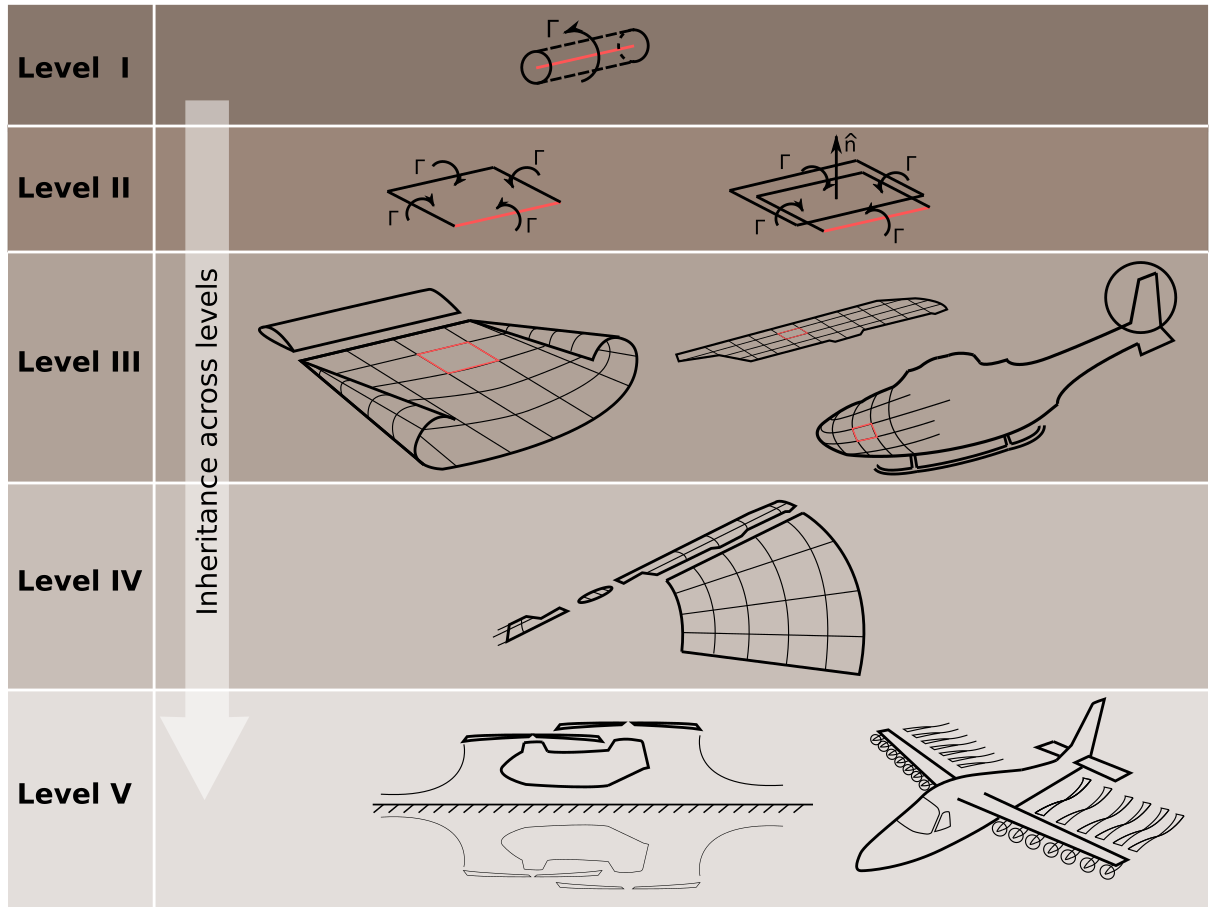
The code is centered around the object-oriented philosophy and is built up using a hierarchical model as shown in the figure. Vortex filaments are used to contstruct wing and wake ring elements. These are further used to construct wing and wake 'sheets' which make up larger aircraft configurations. Ever geometry is assumed to be a rotor at first. For example, a fixed-wing is a non-rotating single-bladed rotor. This rather unorthodox terminology was adopted for the sake of generalization during the initial phases of development.
Code organization
The Fortran source files are present in the src/ folder.
main.f90drives the solver and general program flow.classdef.f90contains attribute and method definitions for the various abstract data types.libCommon.f90contains subroutines that work on higher-level objects and those that deal with general bookkeeping.libPostProcess.f90contains post-processing and data write-out subroutines.libHDF5.f90writes sectional and integrated rotor results to HDF5 format.libMath.f90is an independent math library that contains operations on vectors and matrices.libC81.f90deals with handling C81 airfoil files and is an independent library.gridgen.90converts results from the Lagrangian to an Eulerian framework to better plot pressure and velocity fields on a traditional CFD-like domain.
Data input to the solver is through the files config.nml and geom01.nml which are in namelist format. Namelist files are a Fortran specific ASCII input format that follow a variable name-value ordering. Use the provided script newcase.sh to generate templates of these files.
A few utility codes are provided in tools/ to make plotting and parsing of results easier.
Installation
The solver has the following dependencies:
- CMake
- OpenMP
- LAPACK
- BLAS
- HDF5 (with Fortran support)
- GNU Fortran or Intel Fortran compiler
- Python (Optional; for postprocessing)
- Paraview (Optional; for postprocessing)
The source files utilize a CMake build system. Follow the steps below to generate the volcanor executable.
- Clone the Github repository using
git clone git@github.com:cibinjoseph/VOLCANOR.git - Create a
build/directory in the topmost folderVOLCANOR/. - Change directory to
build/. - Run
cmakefrom this directory pointing to the directory one level below. This will generate a Makefile for your OS and available compiler. - Run
make volcanorto compile all source files and generate thevolcanorexecutable in thebin/folder. Note that the environment variableOMP_NUM_THREADSshould be set to the required number of parallel processes to utilize parallelization.
On a Linux system with gfortran installed, this is achieved using the following commands.
mkdir build
cd build/
cmake ..
make volcanor
For building using Intel Fortran, do FC=ifort cmake ...
Several debug build options are provided in the CMakeLists file. For example, to build without the BLAS libraries and OpenMP parallelization, use make volcanor_noBLAS_noOMP.
Postprocessing
Results are written to the Results/ folder in the case directory. The .tec files contain wake geometry and flow data in Tecplot ASCII format; Paraview or Tecplot can be used to visualize these files. The solver also generates an HDF5 file (fullresults.h5) with sectional and integrated force coefficients, geometry parameters, and time history data organized by rotor and blade, suitable for programmatic analysis in Python (e.g. via h5py) or other tools.